
Step 1: Does the opener respond at all?
If nothing happens, check that the opener is plugged in and the outlet or breaker has power; a tripped GFCI outlet in the garage is a common culprit. Next, look at the wall button for a lock or vacation light, which blocks remotes on many models. Then try the wall button and a remote separately. If the wall button works and the remote does not, try a new battery.
Step 2: Does the opener run but the door stay put?
A hum, a click or a door that lifts a few inches and stops often means the springs are no longer carrying the door's weight. Look above the door from the floor: a torsion spring with a gap in the coil is broken. Stop here. Do not keep pressing the button, and do not pull the emergency release on a door that may have a broken spring, because the door can drop. See spring repair.
Step 3: Does the door start closing and go back up?
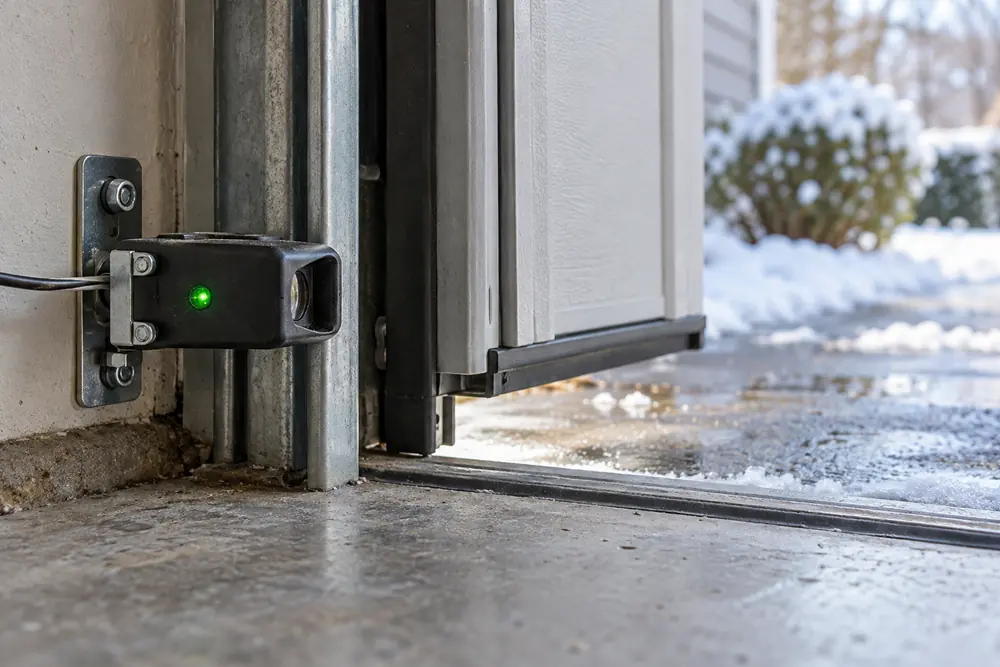
That is the safety system doing its job. CPSC requires openers made after January 1, 1991 to reverse, and added external entrapment protection such as photo eyes in 1993. Check that nothing is in the beam, wipe the lenses and see whether both sensor lights are steady. A blinking light usually means the eyes are out of line. Do not tape or bypass the sensors.
Step 4: Is it cold or wet?
After a freeze, the rubber bottom seal can stick to the slab. Pressing the button can strain the opener or bend the bottom section. Leave it until it thaws or ask for help, and keep water away from the opener and outlets.
Step 5: Is the door crooked or off track?
If one side is lower or a roller is out of the track, unplug the opener and keep people clear. That is an off-track or cable problem, not an opener one.
When the checks are done
If power, controls and sensors look fine and the door still will not move, or you found a broken spring or a loose cable, stop troubleshooting. Note the opener brand, what the lights did and what you found. The opener repair page explains the next level of causes.